

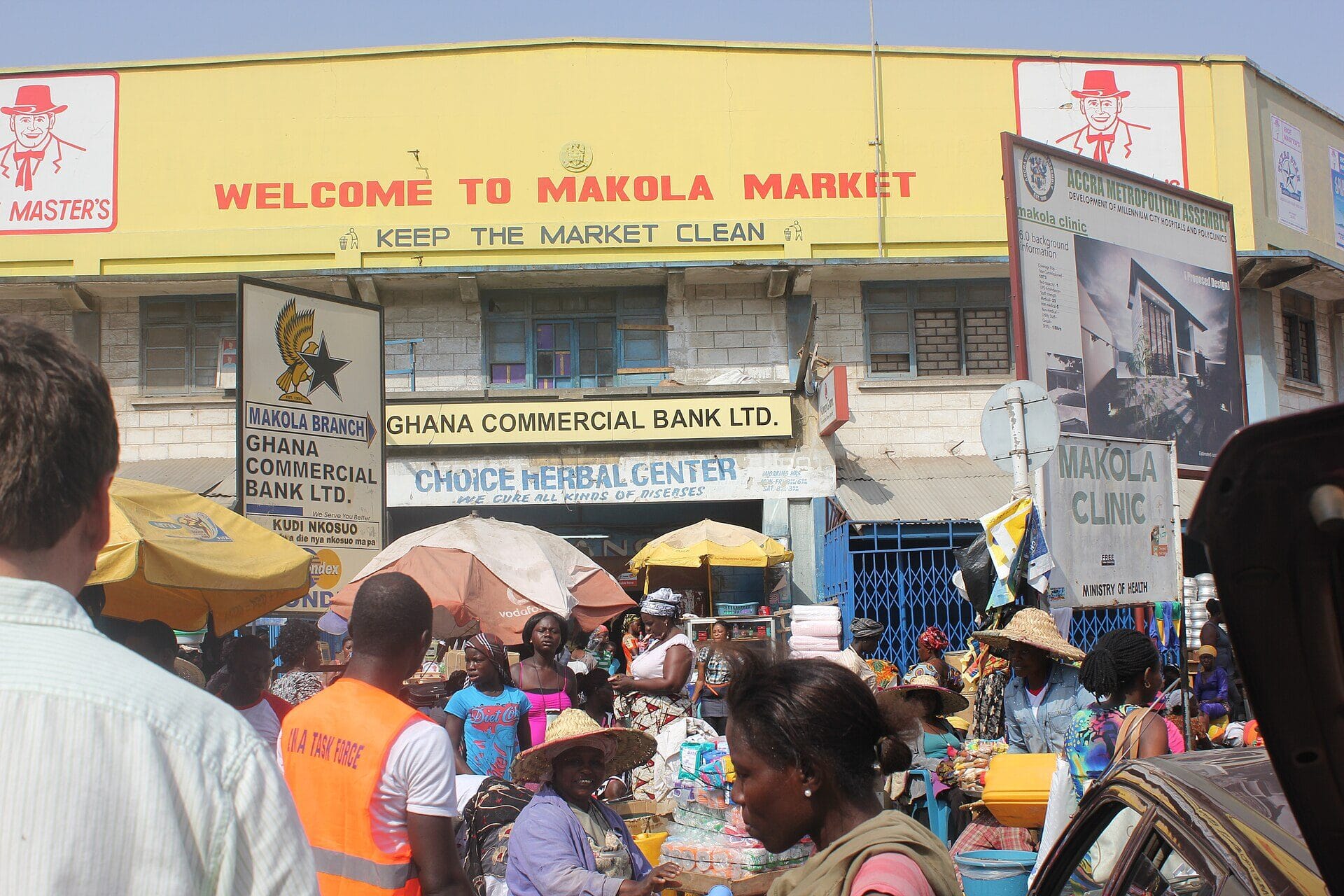
Ghana’s rule keeping foreigners out of petty trading is one of the most heated topics in West African commerce, especially between Ghanaian and Nigerian traders. Here are the facts, set out plainly, with sources for every key claim.
What the law says now
Ghana replaced the old GIPC Act, 2013 (Act 865). The new Ghana Investment Promotion Authority Act was passed by Parliament on 4 April 2026 and received presidential assent on 15 July 2026.1 A foreign-owned trading company now needs a minimum of US$ 500,000 instead of US$ 1,000,000, and at least 75% of its employees must be skilled Ghanaians.2
Small-scale market trading is still closed to foreigners. In October 2026, GIPA CEO Simon Madjie said foreign investors cannot enter Ghana’s informal retail market however much capital they bring, because the law reserves it for Ghanaians.3 This is not a new ban: the restrictions on petty trading have existed since 2013.4 Under the old law, a Ghanaian who lets out a market stall or store to a foreigner also breaches the law.5
Professional Web Design for SMEs
We help businesses and brands scale their customer acquisition and thrive online. Let Ghana’s leading web design agancy develop a premium website for your business today. Click the quote button below to get started;
Why does Ghana have this law?
The aim is to protect jobs, and the job numbers are bad. Unemployment averaged 12.8% over the first three quarters of 2025, and 32.4% for people aged 15 to 24.6 About eight in ten employed people in Ghana work in the informal sector,7 and market trading is the job of last resort for millions. Where there is no welfare safety net, the market stall is the safety net.
Is it discriminatory?
Yes, it treats people differently by nationality, but it does not single out any ethnic group or country. It covers all non-citizens: Chinese, Lebanese, Nigerians and everyone else. Most countries restrict something by nationality.
The real legal problem is ECOWAS. Nigerian traders point to the 1990 ECOWAS Supplementary Protocol on the Right of Establishment, which they read as giving community citizens the right to set up business in any member state.8 Nigeria’s then foreign minister, Geoffrey Onyeama, said the GIPC rules reserving retail trade for Ghanaians conflict with the ECOWAS Protocol.9 That is a fair argument, and Ghana has not fully resolved it.
Is it unfair to Nigerians?
The law itself is not aimed at Nigerians. How it has been enforced is a different story. The thing is; trader groups have often acted on their own: in December 2019, GUTA members locked up over 600 shops belonging to foreign traders, mostly Nigerians, at Kwame Nkrumah Circle.10 In another episode, the Nigerian traders’ union said most of the closed shops had the necessary documentation.11 Shutting shops is the job of the state, not of private groups.
Ghanaians also need to own their part. In January 2026, the Trade Minister said claims that foreigners control about 70% of the retail sector lacked factual basis.12 She also said foreigners are in retail because Ghanaians front for them.13 Every foreign stall in a market was rented from a Ghanaian landlord.
How does Ghana’s population size matter?
Ghana’s projected 2026 population is about 34.4 million.14 Nigeria has about 242 million people in mid-2026, roughly seven times as many.15 Even a small share of Nigeria’s traders moving into Ghana’s markets would make a big difference here. The reverse is not true: Ghanaian traders in Lagos would barely register.
Do other small economies do this?
Yes. It is common, especially in Africa and Asia. Tanzania issued an order in 2025 that bars foreigners from 15 specific business activities.16 Rwanda also keeps a list of businesses reserved for citizens, including retail trade and transport services.17 The Philippines requires foreign-owned retailers to have a minimum paid-up capital of PHP 25 million.18
Other are countries considering such laws now
South Africa is. The MK Party has introduced a Private Member’s Bill to reserve ownership of spaza shops (small township stores) for South African citizens.19 In KwaZulu-Natal, the provincial government is developing a plan to take over spaza shops run by undocumented foreign nationals.20
What advantage would foreign traders have with unrestricted access?
The argument is that bigger players have structural advantages: access to suppliers in a much bigger economy, bulk buying, community credit networks, and sometimes goods that dodged import duty. A local trader with one stall cannot match that on price. The cost falls on Ghanaian traders, many of them women, and on young people with no other jobs.
To be fair, the counterargument is that consumers get lower prices and more choice, and that foreign traders pay rent and create jobs too.
What about someone who has lived here for years, or married a Ghanaian?
The new law got stricter on this. Under the old law, a foreign spouse married to a Ghanaian for five years or more was exempt from the minimum capital requirement. Under the new Act, that exemption is removed.21 Living in Ghana a long time gives no exemption either. The legal route is citizenship.
Smuggling, taxes and different import duties
This is the strongest economic argument. GRA officials estimate that Ghana loses more than USD 2.3 billion in tax revenue each year to smuggling, including roughly 150,000 crates of Coca-Cola products smuggled in from Nigeria every month.22 The Food and Beverage Association of Ghana says large duty differences between Ghana and its neighbours create strong incentives for illegal trade.23 A trader selling goods that dodged duty can undercut one who paid full tax.
But Ghanaians smuggle too. The Finance Minister has complained about heavy smuggling through the port of Togo,24 and customs officers have been exposed taking bribes to let goods through.25 This is a customs-enforcement problem, not just a problem with foreigners.
What about dumping of cheap foreign imports?
The retail law does not stop dumping. Any Ghanaian can import cheap goods. Dumping is handled by the Ghana International Trade Commission, which, for example, refused to waive a 35.77% anti-dumping duty on aluminium coils and circles imported from China.26 If cheap imports are the problem, the fix is anti-dumping cases and customs enforcement, not checking traders’ passports.
Do these restrictions push migrants into crime?
The research partly supports this. Studies across many countries find no simple link between immigration and crime, but making it possible for immigrants to work legally tends to reduce crime.27 A US study found that recent immigrants are more likely to commit income-generating crimes when they are barred from the labour market.28
But Ghana’s law does not ban foreigners from working. It closes petty trading only, and leaves manufacturing, services, wholesale and formal jobs open. The lesson is to keep legal routes to work open, not to scrap the law.
What would happen if every country did this?
Ghanaians abroad would be hit too. A Nigerian community leader warned GUTA that closing Nigerian shops would affect Ghanaians living in Nigeria.29 Nigerian SMEs have already lobbied their government to take retaliatory measures.30 When Tanzania brought in its ban, it sparked a backlash from neighbouring Kenya.31 Nigeria has its own protectionist history: in 2019 it closed its land borders with Benin, Cameroon, Chad and Niger to stop rice smuggling.32 If every country did the same, free movement under ECOWAS and the AfCFTA would mean little.
So the law is legal, widely copied, and understandable for a small country where youth unemployment is above 30%. But its weak points are the conflict with ECOWAS, Ghanaians fronting for foreign traders, and vigilante enforcement. Shutting shops will not fix this. What would help is honest enforcement by the state, closing the smuggling gap, and dealing with Nigeria through ECOWAS rather than through street action.